
“And he entered Jerusalem and went into the temple. And when he had looked around at everything, as it was already late, he went out to Bethany with the twelve. On the following day, when they came from Bethany, he was hungry. And seeing in the distance a fig tree in leaf, he went to see if he could find anything on it. When he came to it, he found nothing but leaves, for it was not the season for figs. And he said to it, “May no one ever eat fruit from you again.” And his disciples heard it. And they came to Jerusalem. And he entered the temple and began to drive out those who sold and those who bought in the temple, and he overturned the tables of the money-changers and the seats of those who sold pigeons. And he would not allow anyone to carry anything through the temple. And he was teaching them and saying to them, “Is it not written, ‘My house shall be called a house of prayer for all the nations’? But you have made it a den of robbers.” And the chief priests and the scribes heard it and were seeking a way to destroy him, for they feared him, because all the crowd was astonished at his teaching. As they passed by in the morning, they saw the fig tree withered away to its roots. And when evening came they went out of the city. And Peter remembered and said to him, “Rabbi, look! The fig tree that you cursed has withered.” And Jesus answered them, “Have faith in God. Truly, I say to you, whoever says to this mountain, ‘Be taken up and thrown into the sea,’ and does not doubt in his heart, but believes that what he says will come to pass, it will be done for him. Therefore I tell you, whatever you ask in prayer, believe that you have received it, and it will be yours. And whenever you stand praying, forgive, if you have anything against anyone, so that your Father also who is in heaven may forgive you your trespasses.” And they came again to Jerusalem. And as he was walking in the temple, the chief priests and the scribes and the elders came to him, and they said to him, “By what authority are you doing these things, or who gave you this authority to do them?” Jesus said to them, “I will ask you one question; answer me, and I will tell you by what authority I do these things. Was the baptism of John from heaven or from man? Answer me.” And they discussed it with one another, saying, “If we say, ‘From heaven,’ he will say, ‘Why then did you not believe him?’ But shall we say, ‘From man’?”— they were afraid of the people, for they all held that John really was a prophet. So they answered Jesus, “We do not know.” And Jesus said to them, “Neither will I tell you by what authority I do these things.””
As Jesus enters the last week of his ministry on this earth, the day after his triumphal entry, he heads into the temple. On his way in, he encounters a fig tree with leaves yet no fruit. Upon seeing the fruitless tree, Jesus curses it then makes his way into the temple courts.
Instead of seeing a place of worship, Jesus experiences a marketplace. The temple was divided into four courts, each made for four distinct groups of people. The first court was the court of the Gentiles (or the nations). Making your way further in, the next court was the court of Jewish women. The third court was for Jewish men (also called Court of Israel), and the fourth and innermost court was made for Jewish leaders (priests, scribes, rabbis, etc.).
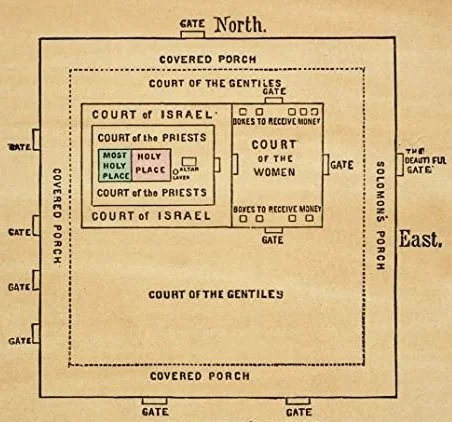
The marketplace Jesus encountered would have been set up in the court of the Gentiles. This explains his quotation of Isaiah 56:7, “My house shall be called a house of prayer for all peoples.” Rather than a place for the nations to encounter God, transactions were being made and money was being earned. The little regard to making God available to all peoples angered the Lord enough to overturn tables and drive out the moneychangers. Jesus leaves, comes across the (now dead) fig tree again and then dialogues with the chief priests, scribes, and elders about the source of his authority.
The fig tree plays a prominent role throughout this passage as it serves as a metaphor to describe religious life in Israel. Israel bore the external signs of fruit-bearing but when it came to producing actual fruit – much like the fig tree – it was barren and fruitless.
Reflection & Confession
As Christ-followers, the fruit we bear by means of the Holy Spirit should be plenty and what we are known for (Gal. 5:22-23).
What about you? Do you give off the impression of fruit-bearing, yet in all actuality, have very little fruit to show anyone?
Do you find your interactions with your spouse, children, parents, co-workers or neighbors truly bearing the marks of following Jesus?
Take some time to confess any shortcomings where you have not borne lasting fruit and ask the Holy Spirit to begin producing more of this fruit in your life as a Christian.